When
Christopher Columbus arrived in Panama
in 1502, he landed at Boca del Drago, on the northern tip of Isla Colon in the Bocas
del Toro Archipelago.
You’ll find it much easier to discover this same tropical beach today. For $5
(round trip) you can take a 40-minute bus ride from the park on Main Street in Bocas Town ,
across the island to Boca del Drago. (The
schedule when I was there was Mon – Sat 6 am, 8 am, 11 am, 1 pm, 4 pm and 6 pm, return trips at 7 am, 10 am, 12
pm, 3 pm and 5 pm. Check current schedules). The bus travels a well-paved road through the farming
and fishing community of the Ngobe Indians. As you pass by the picturesque thatched
roof houses that are home to many of the 300 community members you may envy the
serenity and simplicity of their lifestyle. But, keep in mind, for most, there
is no electricity and water is hauled from creeks.
Thursday, October 25, 2012
Bocas del Drago and Starfish Beach
Labels:
Boca del Drago,
Bocas del Toro,
Starfish Beach
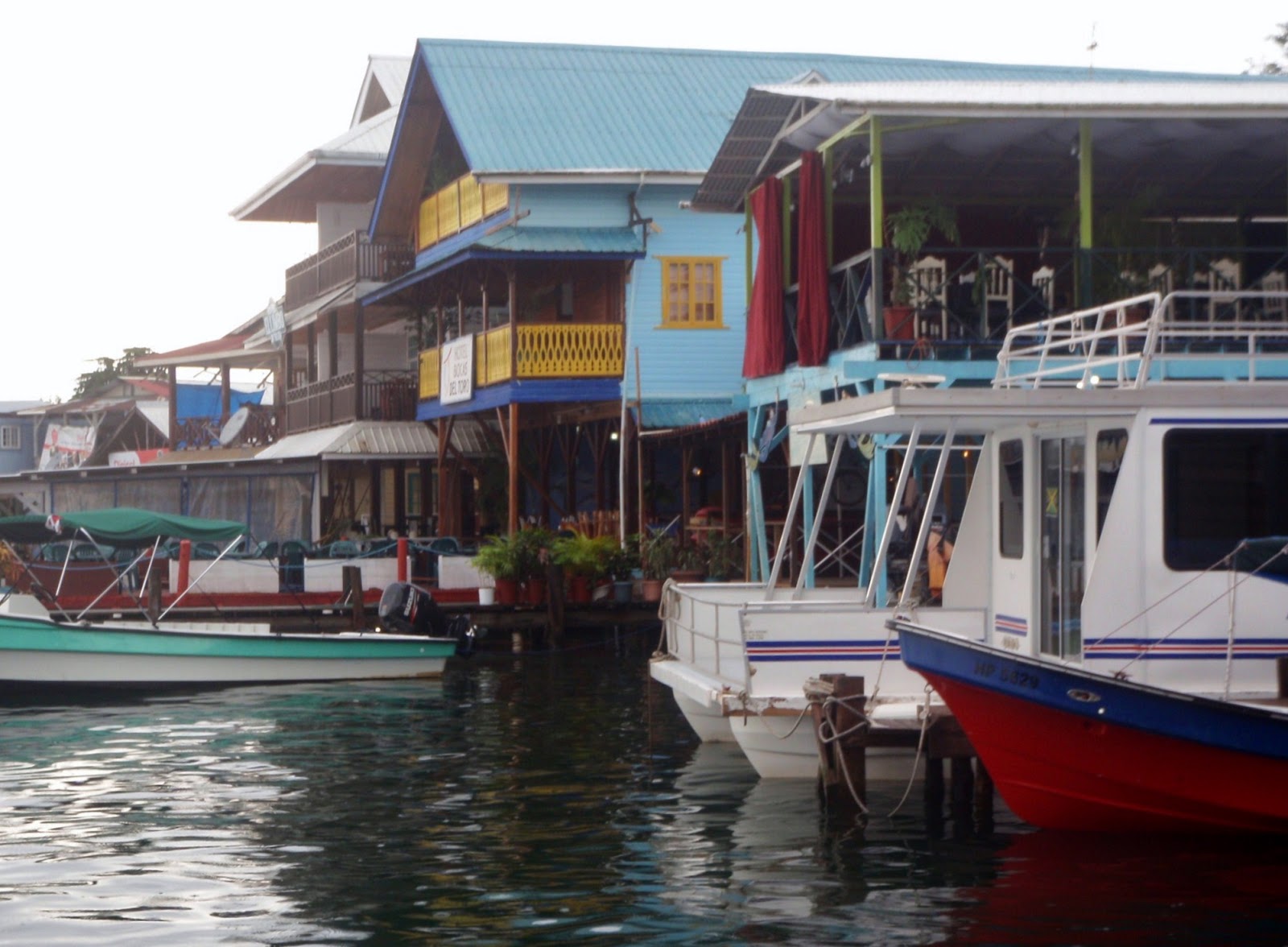
Exploring the Archipelago of Bocas del Toro
When you
arrive in Costa Rica from
the USA
and many other countries, you are “stamped” in with a 90-day Visa. This means
that every 3 months you need to find somewhere else to go for a few days before
returning for another 90-day visit. Because of its proximity, the Archipelago
of Bocas del Toro, Panama, is a very popular choice for many ex-pats and
“virtual tourists” who reside in Costa Rica ’s
Southern Caribbean towns, like us. Local tour
companies offer convenient shuttles that will take you by mini bus and boat all
the way to the main town on Isla Colon, usually referred to simply as Bocas or
Bocas Town ($20 to $33 USD). Or, you can take a local bus to the border (about
$3), walk across the bridge to Panama
and pick up a taxi to the boat docks in Almirante ($10) then a marine taxi over
to Bocas Town ($5). However you get there, it is
worth the trip.
Gordie was taking this opportunity to get his PADI Open
Water Scuba Certification at Starfleet Scuba in the center of Bocas Town .
Although it rained for much of the time we were there, he was up early every
morning and in the water with his instructor every day to successfully complete
the course. This also meant that I was
on my own to explore the islands in the rain.
Day one I took a trip by bus to the other end of Isla
Colon to Starfish
Beach . This trip deserved
a story of its own. See related story.
Day two, I took a marine taxi over to Bastimentos Island ($3). Although this is one
of the largest islands in Panama ,
a large portion of it is protected, being home to the Isla Bastimentos
National Marine
Park , and being home to
the indigenous communities of Quebrada
Sal and Bahia Honda. The settlement you can see from Bocas is a town simply known as
Bastimentos. This was my destination for the day. Once in the boat we were
handed sheets of cardboard to hold up in front of us as splash protection from
the waves. It worked. I was pretty dry when I arrived. Spent a little time
exploring the main street and looking around at a number of rustic hotels and
bars that dotted the coast. Unfortunately the storm clouds were gathering – not
rain clouds, but STORM clouds, so I decided to cut my trip a little short. Went
back to the dock and within minutes another boat arrived to make the return
trip to Bocas. To me, the waves were huge and crazy. To the gentleman sitting
next to me, not so. He proceeded to tell me about his adventures sailing around
the world and tales of waves more than 20 feet high. I guess that made me feel
safer.
Evenings were all together different. Since
Gordie was out of class we were able to go out and try some of the many fine
restaurants in Bocas. We are already planning to return and finish exploring
this area. We’ll be including some scuba diving next time.
Wednesday, August 29, 2012
The Great Banana Harvest
| View from back door - bananas on tree. |
| Tree chopped - Bananas on ground and read to hang. |
Once they are on the ground you string them up and hang them somewhere where the critters cannot reach them. It can take several more weeks for the bananas to totally ripen to a rich yellow. And once they start to yellow they ALL ripen within days. This is when you start contacting your friends and neighbors to see how many they would like. The waiting is over. For now. Before the original tree is ready for harvest it sends out at least one "pup" that takes its place and delivers the next generation of fruit. Bananas for Life. Pura Vida.
Saturday, August 25, 2012
Columbian Sapote, Yum
When friends ask what I like about living in Costa Rica, inevitably my answer includes FOOD. And when I say “food,” I’m talking about the variety of fresh fruits and vegetables available here. Our food discoveries are made at the farmers’ markets or through neighbors wanting us to try something “new.”
We liked the taste of our Columbian sapote so much that we have planted 3 of the 5 seeds. First we soaked the five furry husks in water; then, a couple of days later, we watched in amazement as the husk split open to reveal what looked like a “brain.” Fingers crossed we may have our own trees one of these days. The “Tontorican Sapote.”
Tuesday, August 14, 2012
Celebrating USA Holidays abroad
| Gordie and I with good friends, El and Rosie. |
Tuesday, July 3, 2012
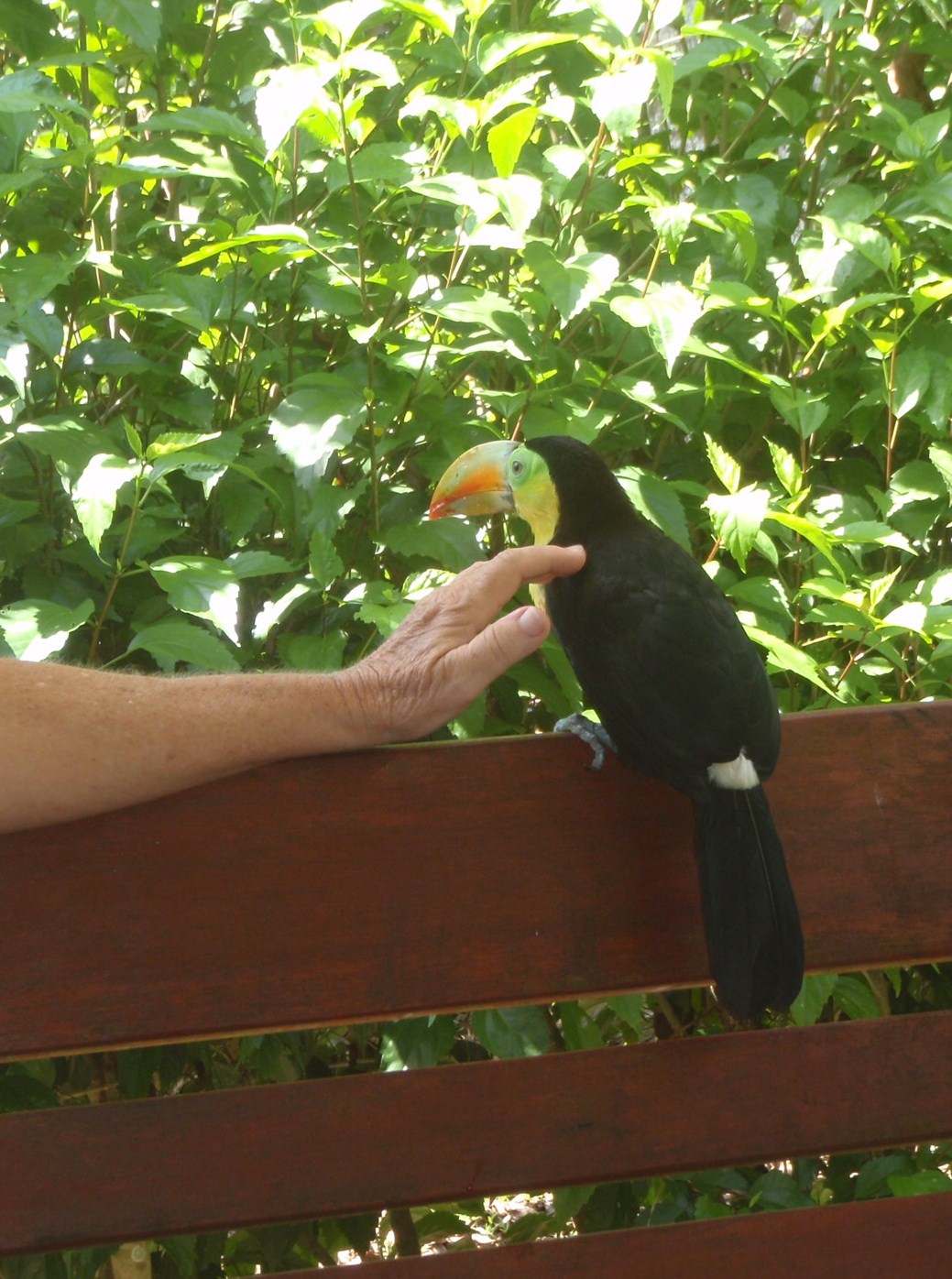
Move over Toucan Sam
I watched him sharpen his bill on the porch railing then proceed to “peck” at my arm. Gordie lightly grabbed his bill and they did a little “arm-to-beak” wrestling. Although he couldn’t laugh, I could tell he thoroughly enjoyed the little game. Toucans are called “softbilled” birds but it is because of the food they eat - primarily fruits - and not the hardness of their beaks. He let me pet him, sat on my arm, and showed no fear of humans. His ability to distinguish colors was very keen. “My Toucan” seemed to favor anything in the yellow-orange range. I was working on a mosaic tile project and he came over to the table and immediately picked out the bright yellow tiles. Next he tried to pick up a glue bottle by its bright yellow-orange cap. He also tried for a yellow-handled paintbrush that was on the table. Finally he hopped over to our planter and picked a yellow habanera pepper off the bush and put it in his mouth. Luckily it fell out of his bill and I was able to swoop in and pick it up before any harm was done. I replaced the hot pepper with a chunk of papaya, and made a friend for life.
He has stopped by once more since then, but only to say “hello.” I hope he comes again. This morning there was a Yellow-ear Toucanet in our Cashew tree. Nice, but I still miss “My Toucan.”
It’s not all surfing
When they think of Costa Rica, many people think of surfing. Naturally. With miles of coastline along the Pacific and Caribbean oceans, Costa Rica offers great opportunities to “hang ten.” But there are also miles and miles of pristine tropical beaches, rivers and creeks for non-surfers to enjoy. That would be me and Gordie.
This year we brought a two-person inflatable kayak to Costa Rica with us and have begun to explore the various rivers and beaches in our area with it. Our most recent adventure brought us a short distance south of Puerto Viejo to the small village of Manzanillo. This is the end of the road in Costa Rica, literally. Our kayaking destination was Simeon Creek which separates Manzanillo from a five-kilometer coastal trail that leads to Punta Mona and the heart of the Gandoca-Manzanillo National Wildlife Refuge. After that, Panama.

We drove to the end of the beach, parked the car and checked out the creek. Inflating the kayak took less than 10 minutes, added a few more minutes to enjoy a hot “paty,” or meat pie, we purchased from a lady on the beach, and off we went. It was everything you would expect a jungle river to be. Very dark, very quiet, tangles of low hanging vines and trees. Just like a movie, but real. Luckily no crocodiles or snakes, that we could see at least. When we tired of the jungle we turned the kayak around and went out to try our hand at ocean kayaking. A little later, kayak deflated, we made our way across Simeon Creek by foot and walked until we found a private, palm-lined beach for snorkeling. Enjoyed an adult beverage under the palms and began our trek back to civilization. Another day in paradise.
Subscribe to:
Posts (Atom)