
Thursday, February 19, 2015
We are not lost in the jungle
I can't believe it has been so long since I updated this blog. We are still spending as much time as we can in beautiful Costa Rica and balancing this with family time in Arizona. Many of the "strange" and "unusual" things we confronted in Costa Rica when we first came here have just become part of our everyday life now. However, from comments I have received, it seems there are still some followers out there who are interested in our journey through retirement and international living. And so, I will be adding new stories, opinions and links in the days and weeks to come. I hope you enjoy what I have to say, and feel free to send me comments. Pura Vida and hasta luego.


Thursday, October 25, 2012
Bocas del Drago and Starfish Beach

When
Christopher Columbus arrived in Panama Main Street Bocas Town
 I was
awakened from my day dreaming by the sensation of pavement suddenly turning to
sand. No, we hadn’t gone off the road, we had arrived at Boca del Drago. A
short distance beyond the tourist restaurants, cabinas and gift shops there was
a small dock with a boat waiting to take me and a few fellow travelers over to
Playa de las Estrellas or
I was
awakened from my day dreaming by the sensation of pavement suddenly turning to
sand. No, we hadn’t gone off the road, we had arrived at Boca del Drago. A
short distance beyond the tourist restaurants, cabinas and gift shops there was
a small dock with a boat waiting to take me and a few fellow travelers over to
Playa de las Estrellas or Exploring the Archipelago of Bocas del Toro
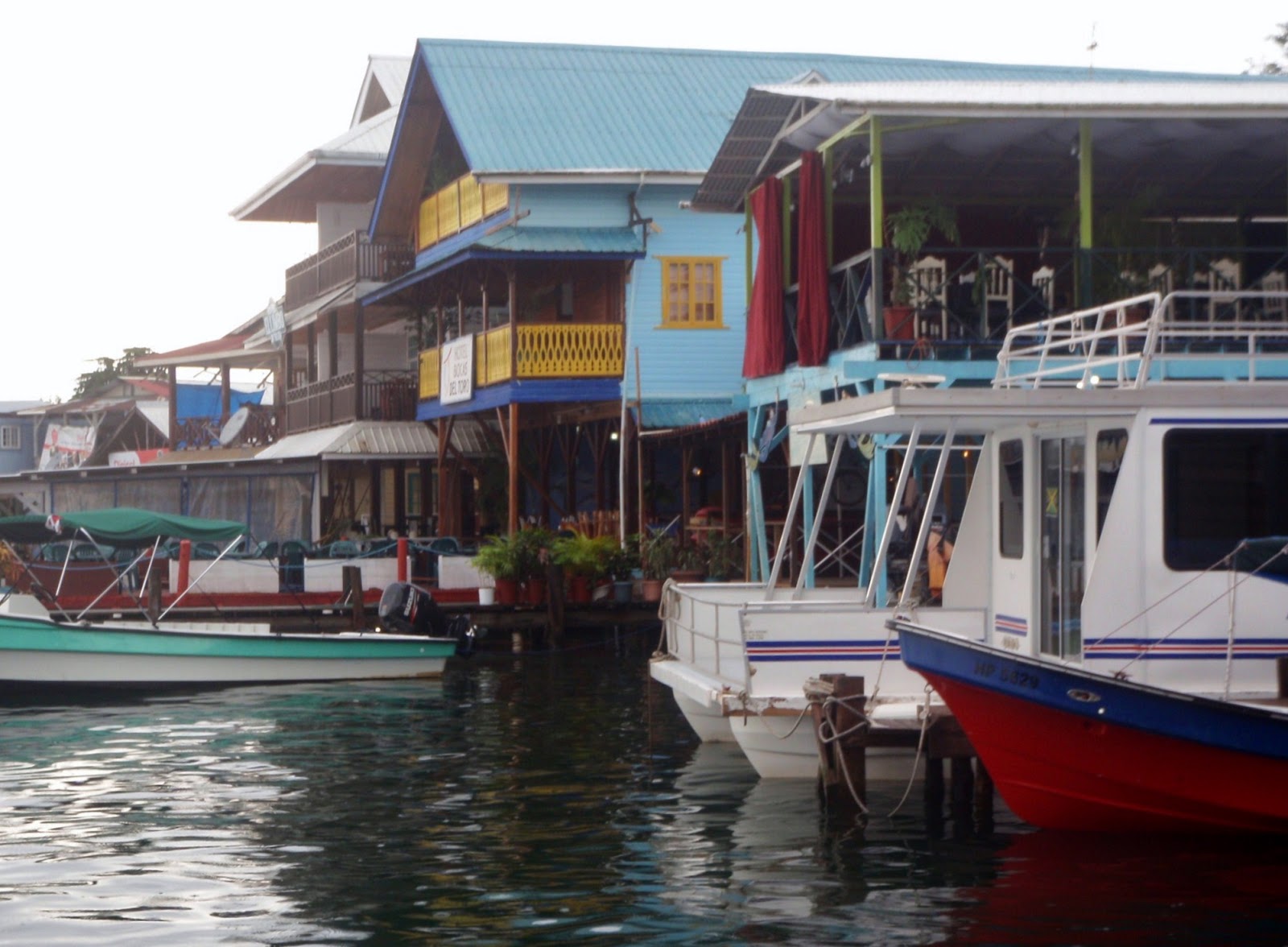
When you
arrive in Costa Rica from
the USA Costa Rica ’s
Southern Caribbean towns, like us. Local tour
companies offer convenient shuttles that will take you by mini bus and boat all
the way to the main town on Isla Colon, usually referred to simply as Bocas or
Bocas Town ($20 to $33 USD). Or, you can take a local bus to the border (about
$3), walk across the bridge to Panama
and pick up a taxi to the boat docks in Almirante ($10) then a marine taxi over
to Bocas Town
Gordie was taking this opportunity to get his PADI Open
Water Scuba Certification at Starfleet Scuba in the center of Bocas Town
Day one I took a trip by bus to the other end of Isla
Colon to Starfish
Beach
Day two, I took a marine taxi over to Bastimentos Island Panama ,
a large portion of it is protected, being home to the Isla Bastimentos
National Marine
Park
 For my Day Three trip I went to
Evenings were all together different. Since
Gordie was out of class we were able to go out and try some of the many fine
restaurants in Bocas. We are already planning to return and finish exploring
this area. We’ll be including some scuba diving next time.
Wednesday, August 29, 2012
The Great Banana Harvest
 |
| View from back door - bananas on tree. |
 |
| Tree chopped - Bananas on ground and read to hang. |
Once they are on the ground you string them up and hang them somewhere where the critters cannot reach them. It can take several more weeks for the bananas to totally ripen to a rich yellow. And once they start to yellow they ALL ripen within days. This is when you start contacting your friends and neighbors to see how many they would like. The waiting is over. For now. Before the original tree is ready for harvest it sends out at least one "pup" that takes its place and delivers the next generation of fruit. Bananas for Life. Pura Vida.
Saturday, August 25, 2012
Columbian Sapote, Yum
When friends ask what I like about living in Costa Rica, inevitably my answer includes FOOD. And when I say “food,” I’m talking about the variety of fresh fruits and vegetables available here. Our food discoveries are made at the farmers’ markets or through neighbors wanting us to try something “new.”
 This week our neighbor, Jaimie, stopped us as we were driving up the road and handed us 2 grapefruit-sized, olive-green fruits and said they were “Columbian Sapotes.” When we got to the house, I immediately looked to see if this was listed on our “Tropical Fruits of Costa Rica” sheet. It wasn’t. There was a Mamey Sapote, but nothing with the word “Columbia.” Oh well, it looked interesting, and safe. We’d give it a try. I made a number of slices into the velvety outer skin and proceeded to open the fruit into sections. Inside the tough green skin was bright red-orange pulp with a mango consistency. So far, so good. But, the big test was still to come. Would Gordie eat it? Hmm. Yes, turns out that Gordie not only tried it, he liked it – quite a bit. Said it tasted better than mango! Quite an endorsement, so I thought I would find out more about this tropical fruit.
 Searching online for information on the Columbian sapote or zapote, I discovered there are actually quite a few fruits called “sapote.” In fact, the term is commonly applied to any number of soft, sweet fruits, and it seems like every country has their own version. In El Salvador, for example, there is the zapote grande; in Panama the mamey de la tierra; in Jamaica, it is marmalade fruit or marmalade plum; in Nicaragua, it may be called guaicume; and in Mexico, chachaas or chachalhaas or tezonzapote.
 We liked the taste of our Columbian sapote so much that we have planted 3 of the 5 seeds. First we soaked the five furry husks in water; then, a couple of days later, we watched in amazement as the husk split open to reveal what looked like a “brain.” Fingers crossed we may have our own trees one of these days. The “Tontorican Sapote.”
Tuesday, August 14, 2012
Celebrating USA Holidays abroad
 |
| Gordie and I with good friends, El and Rosie. |
 Tomorrow, August 15, is Mother's Day, a National Holiday - in Costa Rica. I'm sure my kids don't know a thing about it and we'll continue to celebrate the US version on the second Monday in May. But, it did get me to thinking about how ex-pats celebrate some of their native-country traditional holidays. Take the 4th of July for example. Well, the capital city of San Jose there is an annual "American-style" 4th of July celebration each year featuring hots dogs, games and "traditional" fun activities. We live in a much, much, much smaller area. Even so, this year, Toby, the owner of a local beachside Sports Bar, The Point, put on a 4th of July celectration to rival any. It started mid-afternoon with a pig roast and numerous delicious sides that you would only find in Costa Rica such as yucca. All Free, by the way. There was also live music. And, when the sun went down the sky over the ocean filled with fireworks. It was fun to celebrate with old friends and new, some from the US and some from many other countries around the globe. The beginning of a great tradition. Thanks Toby.
Tuesday, July 3, 2012
Move over Toucan Sam
 It’s not that unusual to see a rainbow-beaked, Keel Bill Toucan in our neighborhood; usually high in a tree or flying by, though. Doesn’t matter, I still rush into the house and grab my camera, zoom and shoot, trying to capture the beauty of these extraordinary birds. To date my photos have had very mixed results. Anyone familiar with “Sam,” the Fruit Loops toucan, would recognize one easily. Their colorful plumage - predominately black body, yellow chest, green around the eyes and a rainbow-colored bill is unique and actually helps them to hide in the trees.
 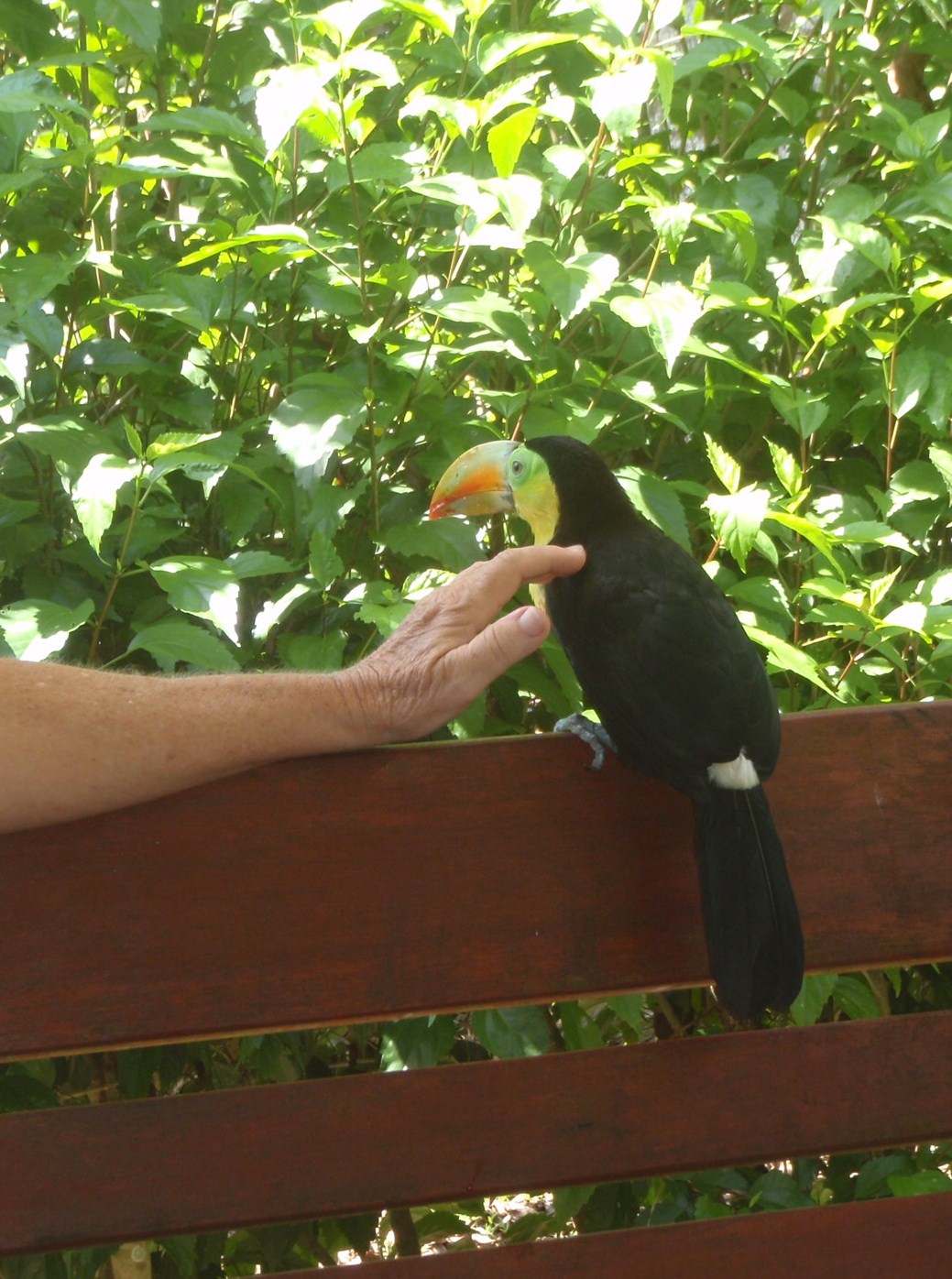 So, you can imagine my surprise the other morning when Gordie and I were sitting on the front porch having breakfast and a Toucan flew onto the table. Seems he really wanted to try the cornflakes that Gordie was eating. Seriously. He continued to hang out with us most of the morning. Sat on the ledge, sat on my leg, checked out the garden to see what we were growing, came into the house and grabbed a tomato off the ledge, all the things you would expect a toucan to do when visiting friends. Eventually he decided it was time to leave and off he flew. The next day – no visit. Day after that, he returned and spent several more hours with us.
I watched him sharpen his bill on the porch railing then proceed to “peck” at my arm. Gordie lightly grabbed his bill and they did a little “arm-to-beak” wrestling. Although he couldn’t laugh, I could tell he thoroughly enjoyed the little game. Toucans are called “softbilled” birds but it is because of the food they eat - primarily fruits - and not the hardness of their beaks. He let me pet him, sat on my arm, and showed no fear of humans. His ability to distinguish colors was very keen. “My Toucan” seemed to favor anything in the yellow-orange range. I was working on a mosaic tile project and he came over to the table and immediately picked out the bright yellow tiles. Next he tried to pick up a glue bottle by its bright yellow-orange cap. He also tried for a yellow-handled paintbrush that was on the table. Finally he hopped over to our planter and picked a yellow habanera pepper off the bush and put it in his mouth. Luckily it fell out of his bill and I was able to swoop in and pick it up before any harm was done. I replaced the hot pepper with a chunk of papaya, and made a friend for life.

He has stopped by once more since then, but only to say “hello.” I hope he comes again. This morning there was a Yellow-ear Toucanet in our Cashew tree. Nice, but I still miss “My Toucan.”
It’s not all surfing
When they think of Costa Rica, many people think of surfing. Naturally. With miles of coastline along the Pacific and Caribbean oceans, Costa Rica offers great opportunities to “hang ten.” But there are also miles and miles of pristine tropical beaches, rivers and creeks for non-surfers to enjoy. That would be me and Gordie.


We drove to the end of the beach, parked the car and checked out the creek. Inflating the kayak took less than 10 minutes, added a few more minutes to enjoy a hot “paty,” or meat pie, we purchased from a lady on the beach, and off we went. It was everything you would expect a jungle river to be. Very dark, very quiet, tangles of low hanging vines and trees. Just like a movie, but real. Luckily no crocodiles or snakes, that we could see at least. When we tired of the jungle we turned the kayak around and went out to try our hand at ocean kayaking. A little later, kayak deflated, we made our way across Simeon Creek by foot and walked until we found a private, palm-lined beach for snorkeling. Enjoyed an adult beverage under the palms and began our trek back to civilization. Another day in paradise.

Sunday, June 24, 2012
Food for thought - or eating
 Is it just me or do most people love the idea of raising their own food? Although I was raised a “city girl,” being able to grow some of my own food gives me a great sense of accomplishment – plus the security of knowing I will never starve. And, it’s cool. I like to walk outside of my house and be able to pick something, anything, that I can add to the meal. I guess Gordie’s passion for gardening has rubbed off on me. Our tomatoes and peppers have always done well in Arizona and in Costa Rica and this year is no exception. But we find that growing food in Costa Rica is especially fun – unlike Arizona, everything grows and grows quickly. You think it - it grows.
 We currently have Basil, Asian cilantro and “normal” cilantro in window boxes, plus wild “Tico” cilantro in the yard. There are string beans are already flowering and baby Romaine should be popping out in the next week or two. Unique to here, of course, are our much beloved fruits – the papayas are getting larger everyday and one of the banana trees is ready to harvest. Then there are the fruits peculiar to our North American taste buds like Cas, Marañón and Mamón chino. They too are growing and growing with no assistance from us. Yum.
Saturday, June 9, 2012
The World of House and Pet Sitting
 |
| House sitting near Cocles Beach, Puerto Viejo |
Could have been fate, or karma, or just plan luck, but somehow we have ended up “sitting” since the first of the year. The first four months of 2012 found us in Arizona sitting for 2 dogs and 2 cats. Then came May and Costa Rica, where we spent 6 weeks house and pet sitting. This time it was in a beautiful home a block from Cocles Beach, a popular surfing spot just outside of Puerto Viejo. The 2 dogs and 2 cats were very well behaved and we shared many laughs watching the 3 little kittens discover their world. It’s June now.
 |
| Artist's hideaway |
Yes, it’s beginning to feel like we are on a permanent vacation. Each place we sit at offers us new neighborhoods to explore, people to meet and new home design ideas. We’ve decided that it’s a lifestyle well suited to us. We’ve already learned to travel light and be open to “whatever.” At this point we are seriously considering registering with some international house sitting services and see what comes of “it.” Perhaps fate, karma and luck have some fun adventures in store for us. Belize, Costa Rica (of course), Columbia, Nicaraqua, Panama, any Caribbean islands, Connecticut and Florida are all high on our list, but, we’re open to anywhere new and exciting.
Wednesday, May 30, 2012
Taking care of business.

Each year your vehicle is required to pass this strict inspection process. You receive a sticker for the front windshield after you pass, and, yes, it is very important to have the sticker. There are transit police (traficos), who periodically set up road blocks to check that your vehicle and papers are current, you really want that current sticker.
Our closest inspection station is about an hour away in Limon. I signed up for the appointment online, we cleaned the car, checked that everything was in order and headed for our first inspection. There were only a few cars in front of us so the process went quickly. There are several “stations” to stop at; first the lights, blinkers, windows and exterior condition of the car. Then, under the hood to check cables and connections. Yes, they care about the WHOLE car. Next they test brakes and shocks. And, of course, they check the car’s emissions. I was very impressed with the whole process and enjoyed watching the results on large monitors at each station. The last station required that we drive and stop over a “pit,” similar to those you see in oil change shops in the US. From this vantage point we were able to watch all the working parts of our car from the bottom up – very cool.
The whole experience was far less stressful than I had anticipated. Unfortunately, we failed the emissions portion of the test. We now had 30 days to have it repaired and retest. Back home, oil change, gas cleaner and a few more tweaks. Next, back to a mechanic in Limon who looked at the results of our previous inspection and sent us on to another mechanic down the road. This mechanic took a look at the results, looked under the car and sent us to another mechanic down the road (everyone specializes here). The sign on this shop was "muflas." Turns out we needed to have a new catalytic converter installed and were able to get that done as we waited. $70 dollars later we had a brand new catalytic converter, passed our test and proudly displayed a bright red 2013 sticker on the windsheild. Business completed. Back to the beach.
Tuesday, May 22, 2012
Aspiring Beachcomber.

Be honest, who hasn’t aspired to be a beachcomber at some point in their lives. I could credit growing up on Long Island Sound or possibly my fascination with old Gidget movies. Whatever the source, it is an aspiration that has stuck with me. Perhaps because the requirements are simple. Location. Check. I am living on the Caribbean Coast of Costa Rica with access to miles and miles of tropical beaches. Free time. Check. Retired. No schedule to keep, except perhaps “Taco Tuesday” at Tasty Waves Beach Cantina. Coconuts. Check. Coconut water, milk, meat. Coconut crusted everything. Coconut oil. Coconut carvings. And lastly, Sea shells to collect. Well, believe it or not, there are not many shells on the beaches. Miles of smooth black, white and golden yellow sand beaches, but not many rocks or shells. Great for swimming, not so great for collecting. Each morning I’d go out and walk along the beach to see what I could discover. My favorite finds have been sea urchin shells. Usually 3 or 4 a day is all I would come across. You can imagine my surprise yesterday morning when I came upon hundreds of sea urchin shells that had washed ashore. I have cleaned them all and already begun to string some to hang on the porch. Something every good beachcomber would do. I think I will be successful in my new endeavor.
Friday, May 18, 2012
Finding special places
The man who doesn't read good books has no
advantage over the man who can't read them. - Mark Twain
As a young child of 7 or so, I
anticipated Mondays. Summer Mondays to be exact. That was the time when mom
would walk us kids up Downs Avenue

Well, I am retired now and
rediscovering the joys of reading just for pleasure. Good books, I like to
think. Many have been titles that were “mandatory” at an earlier stage in life
when reading the “Cliff Notes” seemed to be an acceptable solution. Not now.
Now I am drawn to the language and style of the author as much as the plot. And,
I am recapturing those “special places” to read. One of my favorites, a tree
stump overlooking a creek by the side of my yard in Costa Rica
Saturday, May 12, 2012
Life's simple pleasures

Thursday, October 27, 2011
Continuous Improvement
It's been 4 months since I have updated this blog. We were back in the States - 7 of them to be exact - to attend weddings, visit family, and plant a pumpkin patch.
 Costa Rica is as green as I remember. The 5 banana plants that went in the yard before we left are already approaching 12 feet high. Three of the papaya trees I planted are each about 3 feet high. A fourth papaya is growing in the planter in front of the house - it already has the beginnings of 4 papayas fruits on it - and I don't even remember planting that one!
 Our new "project" on this trip has been a kitchen update and remodel. And, of course, if you remodel one room it ends up affecting several others as well. So, the living room is now larger thanks to repositioning of the entertainment center/bookcase, which opened up the wall between the living room and kitchen. The kitchen has a new, sleeker sink and new shelves. Plus the refrigerator and stovetop cabinet have been repositioned. We're not quite done - still need to tile the work counter, finish the tile behind the sink and replace the old storage shelves with the larger ones we varnished today. It's so open and roomy - I love it! One of the photos shows the "old" version with concrete sink. The other photo shows an in-progress shot of the "new" kitchen. I hope you can tell the difference.
 Costa Rica is as green as I remember. The 5 banana plants that went in the yard before we left are already approaching 12 feet high. Three of the papaya trees I planted are each about 3 feet high. A fourth papaya is growing in the planter in front of the house - it already has the beginnings of 4 papayas fruits on it - and I don't even remember planting that one!
Monday, June 27, 2011
In Search of Leatherback Turtles


Leatherback turtles, the world’s largest turtle species, spend their lives traveling the tropical and subtropical seas of the world. But, amazingly, when they are ready to lay their eggs, they return to the very same beach where they were born. Lucky for us, from February to July, hundreds of these Leatherbacks return to the warm beaches of Gandoca, Costa Rica, to build their nests. The Gandoca Refuge is at the southernmost tip of Costa Rica’s Caribbean coast, about 15 miles as the crow flies from our home. By road it’s more like 50 miles accessible by the highway through Hone Creek to Panama or alternatively by unpaved roads parallel to the beach then over the mountain meeting up with the highway near the Panamanian border.
There are several tour companies in Puerto Viejo that offer all-inclusive trips there but, since we now have a car, we decided to take the drive ourselves. We easily found the small sign on the highway indicating the turn off. Another mile or so down the rural road we came across the free-standing ATM and a fork in the road with a turtle picture and arrow pointing to the left. A few more miles through Del Monte banana plantations, over one small sketchy bridge, and past several monkey trees and we were now in the very, very small community of Gandoca. We continued straight through town to a pristine palm studded beach. At the beach is a prominent sign informing visitors that no one is allowed on the beach between 5 PM and 5 AM during nesting season without a guide. The beaches are patrolled by community volunteers This is one of the many ways that the community protects and preserves the nesting turtles.
We soon found a hostel right next to the beach, procured a guide for the evening and had a bite to eat at a small “soda” - snack bar - in the town. At 8 PM we met our guide on the beach by the “turtle egg nursery” - at this particular turtle nesting area, the locals and volunteers place a plastic bag under the turtle as she lays her eggs. They then bring the eggs to the designated nursery area where they are re-buried in the sand and continually watched until they hatch. We waited for the turtles to come. We waited until midnight but no leatherbacks showed up. Early the next morning we took a stroll along the beach and we able to identify 3 different sets of “turtle tracks.” I guess they came very, very late. Although we were a little disappointed at not being able to see the nesting turtles we had a great trip. We will try again!!!
Celebrating Costa Rica-style


Family is very important to Costa Ricans and the whole family loves to get together to celebrate birthdays, holidays and special occasions. Over Easter weekend we were invited to a neighbor's wedding at a small neighborhood church. The invitations were handmade and delivered in person. The church was decorated by the couple's families with balloons, streamers, local flowers and palm fronds. Reception food was homemade and the 3-tiered cake was made by another neighbor. Although we didn't understand most of what was said, the music was great, and everyone was very welcoming and friendly. We were pleased to be part of this very special day.
On Easter Sunday we attended a special concert at the Catholic Church in Puerto Viejo. The 35-person choir came from throughout the Caribbean coast, from Limon to Puerto Viejo. They were unbelivable good! The Banda National de Limon accompanied the choir to standing ovations. Our town is very small so it was quite a thrill to be entertained by such professional musicians.
Wednesday, April 20, 2011
Bromeliads. They’re everywhere.


Giant century plants, spike-leafed agaves, aloe veras and more. Without a doubt, these terrestrial Bromeliads help create a dramatic backdrop in the Arizona desert.
You’ll also find more than 2,000 different species of Bromeliads in Costa Rica. Some are terrestrial such as the pineapple, but, the majority are epiphytes, or air plants. These grow hard, wiry roots to attach themselves to trees and rocks giving the appearance of a parasite. They’re not. They find, and store, their own food and water. The water is stored at the base of their rosette leaves making a great home for tiny poison dart frogs and other insects.
Plant leaves might be yellow, green, red, striped, spotted and variegated in any number of different patterns. The flowers are brilliantly colored and exotic. We became aware of the enormous variety of Bromeliads that grow in our region when we visited a local beach resort, Banana Azul (see photo). Their elaborately landscaped gardens on Playa Negra in Puerto Viejo feature all types of Bromeliads. This was the inspiration we needed to begin our own collection. With the help of some “volunteer” plants that began to grow at the bottom of a tree in our yard, and the addition of another “store-bought” one, we are off to a good start. If all goes well I will add many more photos in the future. Of Bromeliads and poison dart frogs…I hope.
Wednesday, April 6, 2011
What's in a name?
For several years I had a job that required me to "man the registration desk" as attendees arrived for technical conferences. We would ask for the attendee's "Last Name," and then their "First Name." Sounds simple, right? Depending upon their native country our straight-forward request were sometimes met with a quizzical look or a name that didn't appear on our list. We soon figured out that there's a lot more to a "First Name" and "Last Name."
Traditionally, in the US, a woman marries a man and takes his last name. She may use her maiden name as a middle name or hyphenate it with her husband's, but his name is the "Last Name." They have children and the children take on the same last name as the father. Now everyone in the family has the same last name.
Well, in Costa Rica, a person's "full name" will consist of their unique "First Name," followed by their FATHER's "family name," and then the MOTHER's "family name." Take, for example, Maria Prince Calvo. Prince reflects her father's family name and Calvo reflects her mother's. She now marries John Gonzales Bustamonte. There is no change to her name. Along comes a child. They call her "Mary." Her full name is now Mary Gonzales (father's family name) Prince (mother's family name). In common usage you might also see "Mary" signing her name as Mary Gonzales S. without writing out the third name. It's different than "our way," but seems to add a bit more family history to a person's name.
Traditionally, in the US, a woman marries a man and takes his last name. She may use her maiden name as a middle name or hyphenate it with her husband's, but his name is the "Last Name." They have children and the children take on the same last name as the father. Now everyone in the family has the same last name.
Well, in Costa Rica, a person's "full name" will consist of their unique "First Name," followed by their FATHER's "family name," and then the MOTHER's "family name." Take, for example, Maria Prince Calvo. Prince reflects her father's family name and Calvo reflects her mother's. She now marries John Gonzales Bustamonte. There is no change to her name. Along comes a child. They call her "Mary." Her full name is now Mary Gonzales (father's family name) Prince (mother's family name). In common usage you might also see "Mary" signing her name as Mary Gonzales S. without writing out the third name. It's different than "our way," but seems to add a bit more family history to a person's name.
Tuesday, March 22, 2011
What’s larger than a football, softer than a pillow, and edible?


Give up? It’s the strange looking Guanábana or soursop fruit. Since it thrives in areas of high humidity and warm temperatures, it grows well - and wild - in our Caribbean area.
I first noticed this unusual looking fruit in a Tica neighbor’s tree and asked her what it was and what it tasted like. She explained that the ones we were looking at were not yet large enough to eat. A couple of days later her husband showed up at our door with a ripe, football-sized fruit, along with instructions on how to turn it into a tasty drink, or make “helado,” a frozen ice cream-like treat that is eaten out of a plastic baggy.
I decided to make some of each. So, with knife, plastic bags and blender on hand, I was ready to start.
Step one. Cut the massive fruit in half. The spikes on the exterior were deceiving - they‘re soft.
Step two. Squeeze out the juice and the edible white pulp while making sure to discard the indigestible black seeds. The fruit is extremely juicy - there was juice and pulp everywhere including all over me.
Step three. Into the blender with some milk and sugar (I used a little sweetened condensed milk in place of sugar). No real measurements, just enough till it tasted good.
Since my instructions were verbal and in Spanish, of course, I may have inadvertently taken liberties with the recipe. But, in the end, the Guanábana drink and frozen treats were refreshing and creamy with a sweet and slightly sour taste. I guess it is best described as “unique.”
Guanábana is high in carbohydrates (particularly fructose) with significant amounts of vitamin C, vitamin B1, and vitamin B2. Many herbal medicine practitioners believe the fruit has strong anti-cancer properties and the fruit, seeds and leaves are commonly used among indigenous peoples where the plant is grown.
One Guanábana a year is probably good enough for us.
Subscribe to:
Posts (Atom)